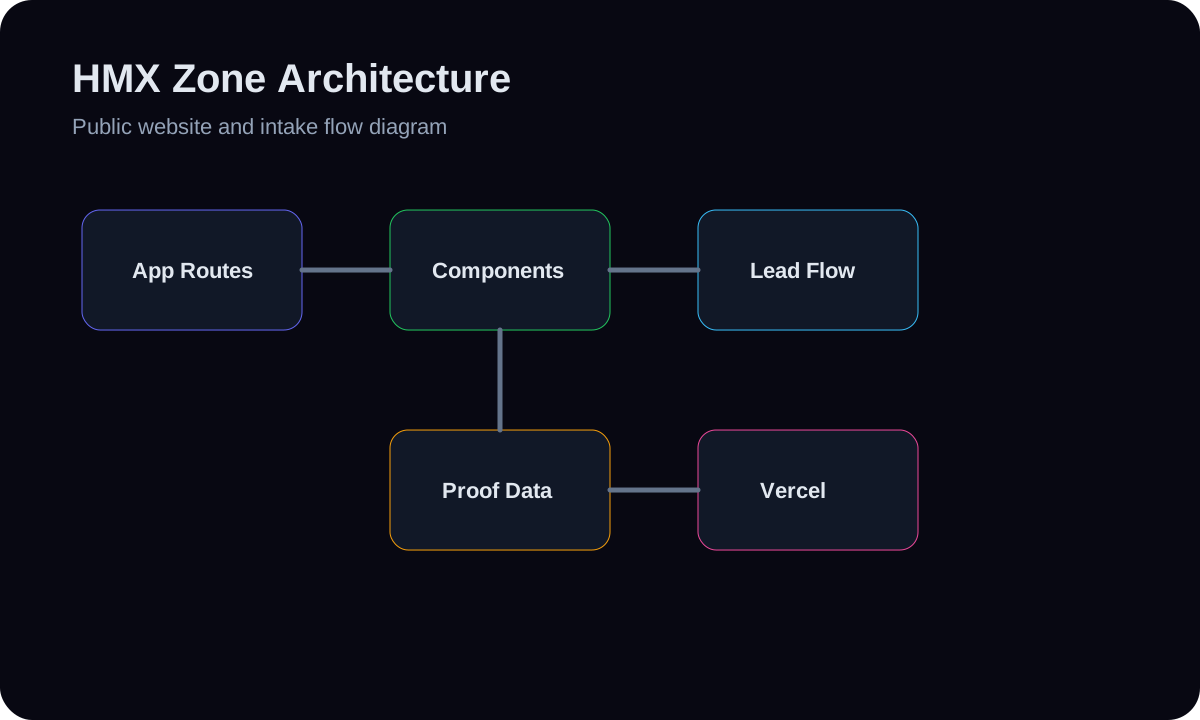
High Websites system

Case Study Renderer

A renderer that turns a typed case-study dataset (stack, workflow, honest outcomes) into consistent service-hub pages, mapping each study to a single service and emitting Article/CreativeWork JSON-LD — presenting real work with realistic capability statements, never invented metrics.

HMX Zone
TypeScript

Verified HMX-owned system

System facts

Case Study Renderer uses a web app route, data, and conversion layer for Full-Stack Websites. A renderer that turns a typed case-study dataset (stack, workflow, honest outcomes) into consistent service-hub pages, mapping each study to a sing... The architecture connects a case-study schema and map, next, typescript, and real builds are presented with an explicit control path.

Outcome

Real builds are presented consistently per service with structured data, using honest outcome statements rather than fabricated figures.

Main risk

A study is double-counted across services or drifts toward inflated, unverifiable claims.

Prevention

One-service-per-study is test-enforced and outcome copy is reviewed to stay capability-based, not metric-fabricated.

Fallback

Studies failing schema or honesty checks are withheld from the hub instead of shipped with weak content.

System architecture

Case Study Renderer Architecture

6 nodes
a case-study schema and map
a layout component that
Next
TypeScript
Fallback Path
Real builds are presented
  1. 01a case-study schema and map

    A renderer that turns a typed case-study dataset (stack, workflow, honest outcomes) into consistent service-hub pages, mapping each study to a sing...

  2. 02a layout component that

    Build a layout component that renders sections consistently with crosslinks to the parent hub

  3. 03Next

    Next.js App Router supports the route, form, or data boundary for Case Study Renderer so public UX and backend state stay connected.

  4. 04TypeScript

    Emit Article/CreativeWork JSON-LD per study for richer search and AI summaries

  5. 05Fallback Path

    Studies failing schema or honesty checks are withheld from the hub instead of shipped with weak content.

  6. 06Real builds are presented

    Real builds are presented consistently per service with structured data, using honest outcome statements rather than fabricated figures.

1-2 weeks

How it is built

A renderer that turns a typed case-study dataset (stack, workflow, honest outcomes) into consistent service-hub pages, mapping each study to a single service and emitting Article/CreativeWork JSON-LD — presenting real work with realistic capability statements, never invented metrics.

  1. 01Define a case-study schema (problem, stack, workflow, outcome) and map each study to one service
  2. 02Build a layout component that renders sections consistently with crosslinks to the parent hub
  3. 03Emit Article/CreativeWork JSON-LD per study for richer search and AI summaries
  4. 04Add a test asserting no duplicate service assignments and that required honesty-safe fields are present

Tools

Workflow surface

  • Next.js App Router
  • TypeScript
  • JSON-LD (Article)
  • Vitest
  • Experience layer: Define a case-study schema (problem, stack, workflow, outcome) and map each study to one service
  • Server layer: Build a layout component that renders sections consistently with crosslinks to the parent hub
  • Database layer: Next.js App Router supports the route, form, or data boundary for Case Study Renderer so public UX and backend state stay connected.
  • Automation layer: TypeScript handles routine steps while one-service-per-study is test-enforced and outcome copy is reviewed to stay capability-based, not metric-fabricated.
  • Measurement layer: Real builds are presented consistently per service with structured data, using honest outcome statements rather than fabricated figures.

Data flow

  1. 01Define a case-study schema (problem, stack, workflow, outcome) and map each study to one service
  2. 02Build a layout component that renders sections consistently with crosslinks to the parent hub
  3. 03Emit Article/CreativeWork JSON-LD per study for richer search and AI summaries
  4. 04Add a test asserting no duplicate service assignments and that required honesty-safe fields are present

Controls and fallbacks

  • A study is double-counted across services or drifts toward inflated, unverifiable claims.
  • One-service-per-study is test-enforced and outcome copy is reviewed to stay capability-based, not metric-fabricated.
  • Studies failing schema or honesty checks are withheld from the hub instead of shipped with weak content.

System path inside the website build

Full-stack websites for service businesses and operators: route architecture, service pages, lead capture, metadata, proof boundaries, blog/database paths, analytics, and deployment checks.

Route map

Service architecture

Clear service routes

01active
Progress72%

Lead capture

Form and context flow

Lead capture that saves context

02active
Progress86%

Public metadata

SEO and schema layer

SEO and schema on public pages

03active
Progress64%

Launch QA

Analytics and deployment checks

Analytics events tied to CTAs

04active
Progress91%

Build this system around your real handoffs.

All systems operational
HMX Zone
(c) 2026 HMX Zone