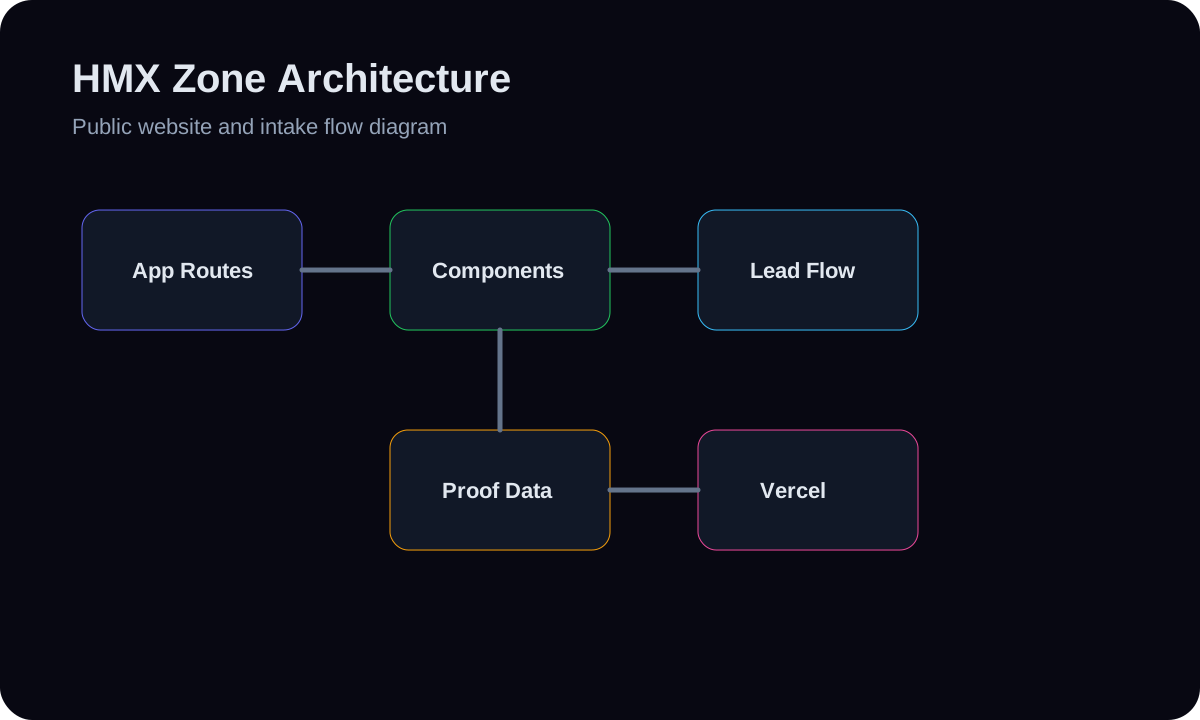
Medium Websites system

Resource Hub Index

A live /resources surface that lists real published blog posts and topic clusters pulled from the active content source (Supabase-backed with filesystem fallback), with counts and last-updated dates computed at request time rather than hand-maintained link lists.

HMX Zone
Supabase

Verified HMX-owned system

System facts

Resource Hub Index uses a web app route, data, and conversion layer for Full-Stack Websites. A live /resources surface that lists real published blog posts and topic clusters pulled from the active content source (Supabase-backed with files... The architecture connects read published posts through, next, supabase, and a self-updating content with an explicit control path.

Outcome

A self-updating content directory that always reflects what is actually published, with no stale hand-edited link lists.

Main risk

The content source is briefly unavailable and the hub renders empty or errors.

Prevention

The adapter falls back to filesystem Markdown and the page degrades to last-known content on read failure.

Fallback

If both sources fail, render a static curated list of evergreen resources rather than an empty page.

System architecture

Resource Hub Index Architecture

6 nodes
Read published posts through
Group posts into topic
Next
Supabase
Fallback Path
A self-updating content
  1. 01Read published posts through

    A live /resources surface that lists real published blog posts and topic clusters pulled from the active content source (Supabase-backed with files...

  2. 02Group posts into topic

    Group posts into topic clusters and compute live counts + most-recent dates per cluster

  3. 03Next

    Next.js App Router supports the route, form, or data boundary for Resource Hub Index so public UX and backend state stay connected.

  4. 04Supabase

    Render the hub with internal links to topics, posts, and the relevant service hubs for crosslinking

  5. 05Fallback Path

    If both sources fail, render a static curated list of evergreen resources rather than an empty page.

  6. 06A self-updating content

    A self-updating content directory that always reflects what is actually published, with no stale hand-edited link lists.

3-5 days

How it is built

A live /resources surface that lists real published blog posts and topic clusters pulled from the active content source (Supabase-backed with filesystem fallback), with counts and last-updated dates computed at request time rather than hand-maintained link lists.

  1. 01Read published posts through the blog source adapter (supabase-only with hybrid/filesystem fallback)
  2. 02Group posts into topic clusters and compute live counts + most-recent dates per cluster
  3. 03Render the hub with internal links to topics, posts, and the relevant service hubs for crosslinking
  4. 04Cache with revalidation so new posts appear without a redeploy but reads stay fast

Tools

Workflow surface

  • Next.js App Router
  • Supabase
  • Markdown content
  • ISR/revalidate
  • Experience layer: Read published posts through the blog source adapter (supabase-only with hybrid/filesystem fallback)
  • Server layer: Group posts into topic clusters and compute live counts + most-recent dates per cluster
  • Database layer: Next.js App Router supports the route, form, or data boundary for Resource Hub Index so public UX and backend state stay connected.
  • Automation layer: Supabase handles routine steps while the adapter falls back to filesystem Markdown and the page degrades to last-known content on read failure.
  • Measurement layer: A self-updating content directory that always reflects what is actually published, with no stale hand-edited link lists.

Data flow

  1. 01Read published posts through the blog source adapter (supabase-only with hybrid/filesystem fallback)
  2. 02Group posts into topic clusters and compute live counts + most-recent dates per cluster
  3. 03Render the hub with internal links to topics, posts, and the relevant service hubs for crosslinking
  4. 04Cache with revalidation so new posts appear without a redeploy but reads stay fast

Controls and fallbacks

  • The content source is briefly unavailable and the hub renders empty or errors.
  • The adapter falls back to filesystem Markdown and the page degrades to last-known content on read failure.
  • If both sources fail, render a static curated list of evergreen resources rather than an empty page.

System path inside the website build

Full-stack websites for service businesses and operators: route architecture, service pages, lead capture, metadata, proof boundaries, blog/database paths, analytics, and deployment checks.

Route map

Service architecture

Clear service routes

01active
Progress72%

Lead capture

Form and context flow

Lead capture that saves context

02active
Progress86%

Public metadata

SEO and schema layer

SEO and schema on public pages

03active
Progress64%

Launch QA

Analytics and deployment checks

Analytics events tied to CTAs

04active
Progress91%

Build this system around your real handoffs.

All systems operational
HMX Zone
(c) 2026 HMX Zone